
The difference between knowledge and salience
and also where I shill about my latest favorite note taking tool: Obsidian
January is the time of year we're all trying to do the dance of being better in a variety of ways.
Me? I recently picked up Uptime by Laura Mae Martin. It's a decent read, but I'm not sure I really learned anything new because (probably unsurprisingly) I have read a lot of books and articles on productivity over the years. Still, as I made my way through the chapters, I had a distinct sense that it was a good use of my time.
Thinking about why, I figured it's maybe helpful today to talk about an interesting distinction between knowledge and salience.
But first, a framework!
The big idea: We can think about systems as having components that can be measured or accessed in fundamentally different ways - as stocks or as flows.
Stock vs. Flow
A stock of something is a quantity that accumulates or depletes over time and and a given moment can be captured as a snapshot.
The flow of something is the rate of movement of that component from one place to another.
A simplified intuitive example is to think of your wealth is the stock of your money while your income and expenses as the flow of money. Often the flow is just the measure of the accumulation or depletion of the stock, but not always. Another metaphor is a lake as the stock of water and an outlet river as a flow, but one that only goes in one direction. Because flow implies a motion, there are considerations around the velocity and throughput of that motion.
A quick aside - a particularly salient example of stock vs. flow that landed with me came from Jerusalem Demsas who's a great reporter on housing and homelessness as a response to a US district court judge, David O. Carter, who decreed that LA provide shelter to everyone living in Skid Row within 6 months. Her article is on this is here, though I heard her on a podcast episode of the Weeds most likely, which is long gone. The point, though, was that this sort of approach of decreeing a fix for the current situation at all costs within 6 months misread the issue of homelessness in major cities because it was in large part a flow problem. Many people go in and out of various stages of housing insecurity regularly, driven by affordability, housing supply (another stock problem!), etc. so even if you did fix the stock problem for the snapshot inhabitants of Skid Row, you wouldn't fix the underlying issue that would replenish the stock. Obviously the answer is to address both things, not just flow, but I thought it was a really good example.
Knowledge vs. Salience
I think knowledge and salience work in a similar way. I think of knowledge as the sum of information acquired and stored (and forgotten) over time in the recesses of our brains. Salience is the flow of information into our consciousness, or put more simply, what is top of mind for us. Using the lake and river metaphor above, our knowledge is the lake, but what's salient for us is the water we can see from one particular point on the riverbank. There is a fundamental constraint in how much water we can see at once, and it can go fast!
AI is, of course, everywhere now and one interesting quirk of this future is that it has brought us a maximalist relationship between stock and flow. That is, when you have access to presumably all of the world digitized information, you have essentially stockmaxxed, so you realize the crux of what is important to us is actually the flow of information.
I suspect this wasn't always the case; only decades ago we were truly knowledge constrained, especially as individuals. We are now probably still collectively knowledge constrained (i.e. there are things our societies have yet to discover) but as people pret-ty overwhelmed with information. We are still limited by what we can focus on; this is a flow problem where the core issue is throughput. Even to engage with AI, we find ourselves with the burgeoning art and science of "prompt engineering" (I like Anthropic's guide) to help make sense of inputs and outputs from a LLM that sort of "knows" everything, but still needs to make it make sense for our brains.
This actually reflects a shortcoming on our part, right?
We go through our lives as highly efficient idea and behavior sponges, but what really matters for us in a given situation is our ability to access those ideas and behaviors in the moment. That can happen through recall, emotion or some sort of external input. In fact, that's happening all the time, whether we realize it or not.
I think maybe attention is the ability to actually actively modulate that access to our nervous system - to do it intentionally instead of having it be done to us. More on that later.
But yeah, I think the experience of reading this book on productivity was the actual valuable thing. It forced me to focus my attention on a set of things I had already known and, with all my January desire, helped me both process things that I had heard before (chronotypes!) and more importantly just channel energy for things that I knew were important but hadn't thought to prioritize. I suspect as the year wears on, salience is going to be the thing that really helps me get done what I want to this year.
And honestly, whenever I waffle on here, salience - moreso than knowledge - is what I'm expecting this column drives for you most months, dear reader.
Why I love Obsidian
In a funny way this brings me to goal that I set in January of last year. After many years of idle consideration, I decided I'd finally give a real shot at landing on a personal knowledge management system (PKMS). I had tried Evernote and Google Docs sparingly since the mid-aughts, and recently failed spectacularly at understanding how to even use Notion in 2019, and none of it really stuck because I'd always get lost in the overwhelm of stock - how would I ever find something I read or wrote 7 years ago?? Sure search exists, but how would I even know to look?
Enter Obsidian, which has fundamentally changed how I engage with information and helped me fall in love with the experience!
The core thing that it does is simple but brilliant: it allows bidirectional linking of notes. If I'm writing something that mentions memory, I can simply put memory in double square brackets ( e.g. [[memory]]) and it links it as a page (even though it doesn't make a real page until I click on the link).
If I then go through and do that with other notes or content that I have in my vault, it will make connections between notes that mention [[memory]] for me and display it in a connected web. Like this:
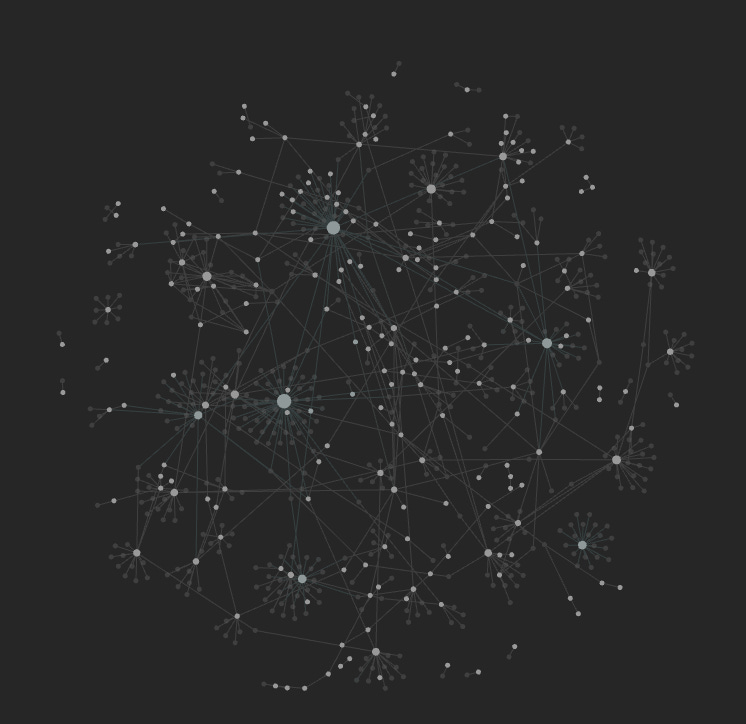
This is my nascent web. Some people go as far as to call this web a second brain, but I have really taken to the word exocortex which just simply so metal.
Now what's fun here is that you can pull on specific strings! For example, I've previously written about motivation and the relative autonomy continuum. But I've also run into motivation in things I've read, so now what I can do is look at the motivation node in my web and it will highlight for me the specific places where I've read about it, and I can click though and get to the notes to better understand contexts.
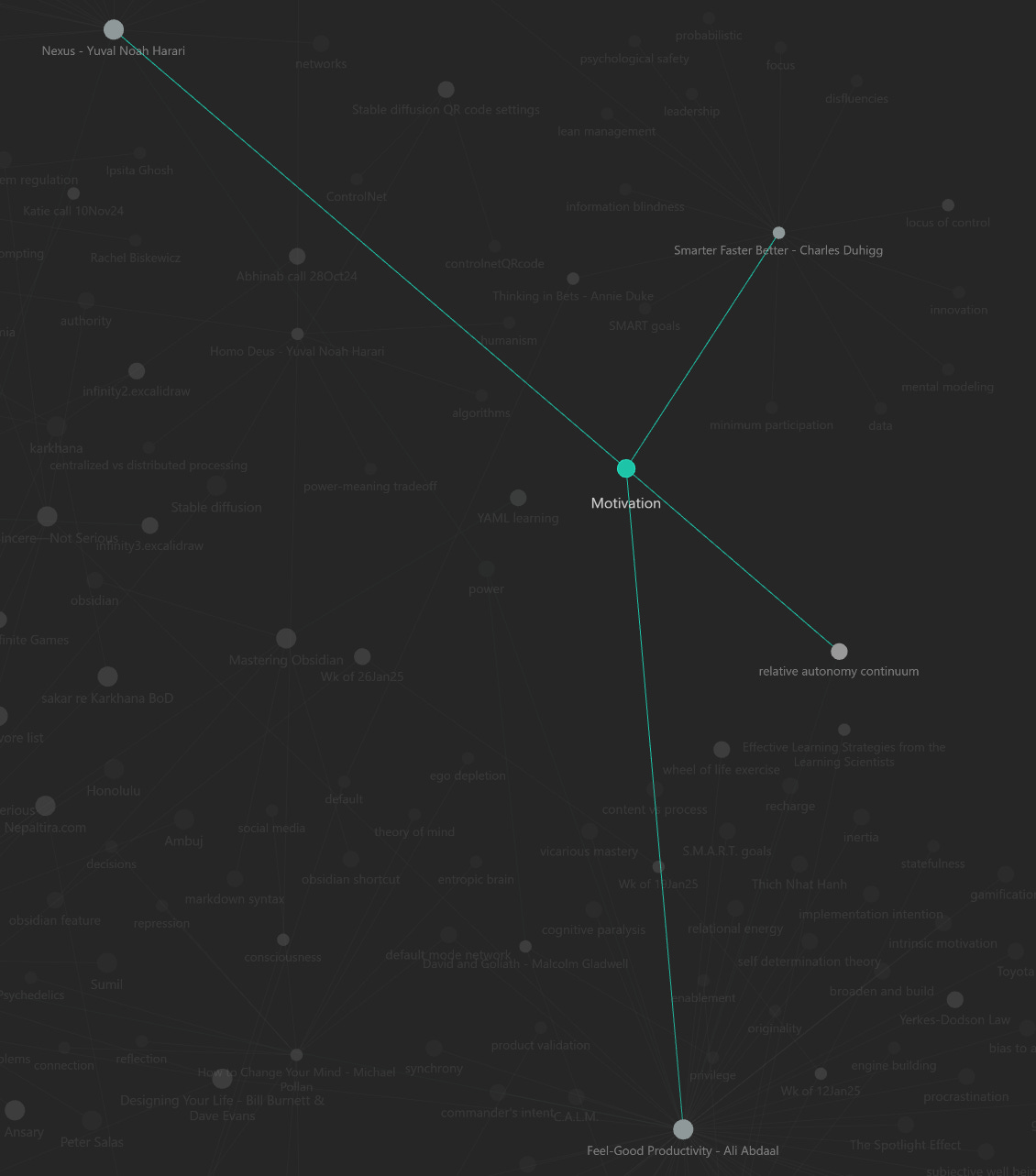
So this shows me that when it comes to motivation, I’ve encountered it in 3 different books and also found a closely related concept before
This helps me make connections between multiple things and when I'm going down a path with an idea, I can link it and see where else it's come up before - this is salience!
For me that has actually been really really helpful because I am a bit of an omnivore and I like to guzzle down a lot information. In big part it's because I just enjoy the process of nonfiction, but in some part it's because I am always really excited to learn new things. Sometimes those two instincts exist in tension with each other. My desire and Desperation to understand and learn new things often get in the way of my enjoyment of the content itself. That's something I'm still working on smoothing out.
One potential solution: passive capture and a new personal project
I have LONG been a fan of passive capture. I will write a whole post on this one day, but in this context, I am working through a personal project that will help me not worry so much about pausing to jot down every interesting thing I hear on a podcast.
The workflow I have (including a generated script using replit - I can't code but that can't stop me!) can:
take a podcast RSS feed as input and temporarily download the audio
transcribe it locally using OpenAI's Whisper to generate a transcript
feed it into a LLM to give me a summary with callouts for key frameworks and concepts and format them with double brackets for obsidian
I've tried it on a few podcasts so far and I'm so excited for this! I can basically pre-generate the summary and then once I listen to the podcast, go back and add stuff and make more connections. I'm hoping this will help me actually engage better with the things I consume. I'm hoping to work out in the coming months a low-barrier workflow to do this with articles and newsletters as well.
By the way, you can also do this pretty easily. Most mainstream podcasts now very readily provide transcript pages, and those are better than the transcripts I generate because they attribute words to speakers, so the LLM can parse that way better. See if something like this works for you, or let me know if you've thought about this problem another way and have found a solution that works differently!
Or if you think this whole endeavor is cursed, get at me too - honestly I don't get any hate mail here and 0 is probably too low?

Do you think salience can be regarded as mindfulness to some extent?